Fire Damage Restoration Explained: How Professionals Repair Your Home
A house fire doesn’t just damage a structure—it disrupts your life. One moment everything feels normal, and the next you’re standing in a space filled with smoke, charred materials, and uncertainty about what comes next.
For most homeowners, a fire loss is unfamiliar territory and it’s easy to feel overwhelmed. It’s often the first fire you’ve ever experienced, and maybe even the first insurance claim you’ve ever had to file. Dealing with a house fire comes with all sorts of emotions but you’re immediately faced with tough questions about how to get your home and your family back to normal.
What does the restoration process look like? How long does it take? And most importantly, how do professionals make sure your home is truly safe to return to?
We’ll break it all down step by step, in clear, straightforward terms—so you know what to expect and can make informed decisions during a stressful time. Because while the aftermath of a fire can feel overwhelming, it’s also the starting point for restoring your home and moving forward.
What Is Fire Damage Restoration?
It’s so much more than just a cleanup—it’s a full-scale process of bringing a fire-damaged property back to life.
Calling fire damage restoration “cleanup” is like calling surgery “a quick fix.” It doesn’t even begin to capture the complexity of what’s involved. At its heart, fire damage restoration is about cleaning, repairing, and rebuilding after fire and smoke have wreaked havoc.
It’s a meticulous, step-by-step process that goes far beyond sweeping up debris.
It involves clearing out damaged materials, removing smoke and soot residue, deodorizing every inch of the structure, repairing or rebuilding what’s been compromised, and even restoring personal belongings when possible.
The ultimate goal? To get your home as close to its pre-fire condition as humanly possible.
Why You Need the Pros
You need to hire the right restoration contractor so you can just focus on yourself and your family.
Professional fire damage restoration teams are trained to identify hidden damage, use material-specific cleaning methods, and address health and safety risks that homeowners cannot safely handle on their own.
Fire damage is not just cosmetic. Smoke, soot, and heat can compromise structural materials, contaminate indoor air, and leave behind corrosive residues that continue damaging your home long after the flames are out.
The goal isn’t just to make the home look better—it’s to make it safe, structurally sound, and fully livable again.
The Science of Smoke and Soot During a Fire
During a fire, smoke and soot don’t stay contained to the room where the fire starts. Heat and pressure force smoke to move through cracks, wall cavities, ceilings, and ventilation pathways, spreading damage throughout the home—even into areas that may look unaffected.
Smoke particles are extremely small and can cling to surfaces, penetrate porous materials like drywall and insulation, and travel through HVAC systems. In many cases, soot also carries acidic by‑products created during combustion, which can corrode building materials, damage electronics, and cause long‑term odor issues if not properly addressed.
This is why professional smoke and soot remediation is critical. Proper cleaning goes far beyond what’s visible, ensuring hidden contamination is removed and the home is truly restored—not just cleaned on the surface.
Step-by-Step Fire Damage Restoration Process
Fire damage restoration is not a single task—it’s a coordinated, multi‑phase process designed to address visible damage, hidden contamination, and long‑term safety concerns. Each step builds on the one before it to ensure the property is restored correctly.
Step 1 – Emergency Board‑Up and Temporary Stabilization
The first priority after a fire is completing the emergency services your insurance requires to properly mitigate the fire.
Firefighting efforts often leave behind significant water damage. Moisture can penetrate drywall, flooring, insulation, and structural components if not addressed promptly.
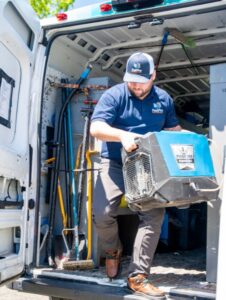
Restoration professionals may use industrial‑grade pumps, air movers, and dehumidifiers to extract water and dry affected materials. Proper drying is essential to prevent secondary issues such as mold growth, material deterioration, and long‑term structural problems.
They may also board up broken windows and doors, install temporary tarps over damaged roofing, and reinforce compromised structural areas. These measures help prevent rain, wind, or vandalism from worsening the damage and ensure the property remains safe until restoration work can progress.
Smoke, soot, water from firefighting efforts, and structural instability can all pose serious safety concerns. Taking the right steps early is critical to protecting what remains of the property and setting the stage for proper restoration. This step creates a controlled, stable environment and serves as the foundation for everything that follows.
Step 2 – Fire Investigation, Origin & Cause, and Scene Release
If the cause of the fire is unclear or suspected to be intentional, authorities may conduct an origin and cause investigation. During this time, access to certain areas of the property may be limited to preserve evidence. This is a normal part of the process that is nothing to be stressed about as long as arson was not involved.
While emergency stabilization can often proceed, full restoration work, including debris removal and demolition, typically cannot begin until investigators complete their work and the scene is officially released by the fire investigator.
Once the investigation is complete and the scene is cleared, restoration efforts can move forward without restriction.
Step 3 – Detailed Inspection and Insurance Coordination
With the scene released, restoration professionals perform a comprehensive inspection of the property. This includes evaluating structural integrity, identifying the extent of smoke and soot migration, assessing water damage, and determining which materials can be cleaned versus replaced.
Certified project managers then coordinate an on‑site walkthrough with the homeowner and insurance adjuster to review the scope of work required to fully restore the property. This step is critical to ensuring all damage (both visible and hidden) is properly documented and addressed.
Step 4 – Soot and Smoke Residue Removal
Smoke and soot often spread far beyond the area where the fire started, and understanding the difference between the two is critical to proper restoration.
Smoke is airborne during an active fire. It is a mixture of hot gases, vapors, and microscopic particles created during combustion. Driven by heat and pressure differences, smoke moves through rooms, wall cavities, attics, and HVAC systems. Even when flames are confined to one area, smoke can contaminate large portions of the structure. Smoke damage is often identified by strong odors, discoloration of surfaces, and contamination of indoor air quality.
Soot is what remains after smoke cools and settles. It is the solid byproduct of incomplete combustion and is made up of unburned carbon particles and chemical residues. Soot is visible and tends to settle on walls, ceilings, contents, and structural materials. Depending on what burned, soot can be dry and powdery or oily and sticky. In all cases, soot is acidic and corrosive, meaning it continues to damage materials long after the fire is out if it is not properly removed.
While smoke spreads contamination, soot is what causes lasting surface damage.
Proper removal requires more than wiping down surfaces. Restoration professionals begin by identifying the type of residue present and the materials affected. Using the wrong method can smear soot, drive it deeper into porous surfaces, or permanently set stains.
To safely remove smoke and soot residue, trained technicians use HEPA‑filtered vacuums, dry cleaning sponges, and material‑specific cleaning agents to lift contamination without spreading it. Walls, ceilings, contents, and structural components are cleaned using controlled methods based on the surface type. At the same time, air filtration equipment is used to capture airborne particles and protect indoor air quality during the cleaning process.
This step is essential to stopping ongoing corrosion, eliminating contamination, and preparing the property for the next phases of restoration.
Step 5 – Contents Cleaning, Deep Cleaning, and Demolition
Many personal belongings can be restored with the right techniques. Items such as furniture, clothing, electronics, and household contents are evaluated individually and cleaned using specialized methods including ultrasonic cleaning, specialty dry cleaning, and antimicrobial treatments.
Contents are categorized as either salvageable or non‑salvageable. If items cannot be restored, our team will help you document and inventory everything in your home so you can submit it to your insurance carrier for reimbursement. If items are salvageable, our dedicated contents team handles the entire process—from pack‑out and professional cleaning to secure storage and careful pack‑back of your clothing, furniture, electronics, appliances, and even heirlooms.
Affected areas of the home are thoroughly cleaned and sanitized to address contamination from smoke, soot, and water. This step is critical for protecting indoor air quality and preserving as much of the structure as possible.
Depending on the extent of the damage, building materials may be restored when feasible. If restoration isn’t possible, damaged materials are safely removed to prepare the home for the next phase of repairs.
Step 6 – Odor Neutralization and Air Quality Restoration
Smoke odor doesn’t simply fade on its own. Odor‑causing particles embed deep into building materials and contents, requiring professional treatment to fully eliminate them.
Restoration teams use air scrubbers, thermal fogging, ozone treatments, and other advanced techniques to neutralize odors at the source and not just mask them. This step ensures the home smells clean and that indoor air quality is safe for occupants.
Step 7 – Structural Repairs and Rebuild
The final phase of restoration is rebuilding the home and returning it to its pre‑loss condition. Depending on the extent of the damage, this may involve replacing drywall and insulation, repairing or installing flooring, rebuilding damaged rooms, or completing more extensive structural repairs.
This phase is typically the most time‑intensive part of the process. Insurance carriers often require approval of the full scope of repairs before work can begin, and if there is a mortgage on the property, coordination with the mortgage company may also be required.
While the rebuild phase takes time, it’s often the most rewarding. This is when homeowners start to see their house truly coming back to normal. As repairs near completion, our contents division will guide you through the pack‑back process—returning your belongings clean, organized, and carefully placed—so your house once again feels like home.
Types of Fire Damage (And Why It Matters)
The type of fire that swept through your home plays a huge role in how restoration teams approach the cleanup. Different fires leave behind different kinds of damage, and each one requires its own unique strategy to fix.
Take protein fires, for example. These are the ones that happen in the kitchen—think burnt food or grease fires. They might not leave a ton of visible damage, but they sure do leave behind a strong, lingering odor and a greasy residue that’s tough to clean.
Then there are natural fires, caused by burning wood or paper. These produce dry soot that’s easier to clean but can still settle into every corner of your home.
Synthetic fires are a whole different beast. When plastics or other man-made materials burn, they create sticky, toxic residue that’s not only hard to remove but also hazardous to your health.
Electrical fires can be especially tricky because the damage is often hidden behind walls or in wiring, making it harder to spot and repair.
Knowing the type of fire helps restoration experts figure out the best way to clean, repair, and restore your home. It’s not a one-size-fits-all situation—our certified experts have a tailored approach based on what your home has been through.
Health Risks After a Fire
Here’s something a lot of people don’t realize: even after the flames are out and the smoke has cleared, your home can still pose serious health risks. Fire damage isn’t just about what you can see—it’s about what’s left behind in the air, on surfaces, and even in the structure of your home.
Toxic soot particles are a big concern. These tiny particles can linger in the air and settle on surfaces, and breathing them in is definitely not something you want to do.
Then there’s carbon monoxide residue, which can stick around long after the fire is out.
Add to that the potential for mold growth from water damage (thanks to all that water used to put out the fire), and you’ve got a recipe for some serious health hazards.
Airborne contaminants are another issue. Fires release all kinds of chemicals and particles into the air, and without proper cleaning and air purification, those contaminants can stick around, making the air in your home unsafe to breathe.
So, while it’s natural to focus on the visible damage after a fire, don’t forget about the invisible risks. Your health and safety are just as important as repairing the structure of your home, and addressing those hidden dangers is a crucial part of the restoration process.
How Long Does Fire Damage Restoration Take?
The real answer isn’t a one-size-fits-all timeline. Fire damage restoration timelines vary based on the severity of the fire and several factors outside of the restoration contractor’s control.
In cases involving minor damage, initial cleaning and deodorization may be completed within a few weeks. More extensive fires—especially those involving structural repairs—can take months for the upfront mitigation and stabilization work alone.
Insurance approvals, mortgage company requirements, scope reviews, material availability, code upgrades, and permit timelines can all impact the overall duration of the project. These steps are necessary to ensure the work is completed properly and that the property is fully indemnified under the insurance policy.
While the process can feel slow at times, each phase plays a critical role in protecting the long-term safety and value of the property. Rushing restoration often leads to missed damage and costly issues down the road. Claims also tend to move more efficiently when you work with a contractor experienced in navigating the insurance process—not just one promising an unrealistically fast return home.
We’re called FastPro for a reason. We do everything we can to move the process forward efficiently while making sure the job is done right.
How to Choose the Right Fire Damage Restoration Company
The team you choose will play a huge role in how smoothly and quickly your home gets back to normal, so it’s worth taking the time to find a company that really knows their stuff.
First things first, not all restoration companies are created equal. Some might promise the world but lack the expertise or resources to deliver.
So, what should you be looking for?
You’ll first want to make sure their team is certified by reputable organizations like the IICRC (Institute of Inspection, Cleaning and Restoration Certification).
This tells you they’re trained to handle fire damage properly and safely.
Experience matters too, especially when it comes to navigating insurance claims.
A good restoration company will not only know how to repair your home but also how to work with your insurance provider to make the process as stress-free as possible.
Finally, you want to hire an independent restoration company who works for you and not the insurance company. This is a critical step to ensuring you are working with a company who has your best interests in mind and not the insurance company that owes you the money.
Now, before you commit, don’t be afraid to ask questions.
How quickly can they start?
What’s their restoration process like?
Do they handle insurance claims?
And finally, can they provide references?
A reputable company will have no problem connecting you with past clients who can vouch for their work. Or simply check their reviews online on Google, Yelp or Facebook.
Choosing the right fire damage restoration company isn’t just about fixing your home—it’s about finding a team you can trust during one of the most stressful times in your life.
Take your time, ask the right questions, and go with the company that gives you confidence and peace of mind.
Wrapping It All Up
Recovering from a fire is about so much more than just fixing walls and replacing furniture—it’s about finding your footing again and restoring a sense of normalcy and peace in your life.
Fire damage restoration isn’t a simple task.
It’s a detailed, multi-step process that demands skill, precision, and the right tools to get it done right. From the very first inspection to the final touches of reconstruction, every single step matters.
It’s not just about cleaning up the mess; it’s about carefully piecing your home back together, one layer at a time, until it feels like yours again.The road to recovery might seem long and uncertain, but here’s the good news: you don’t have to walk it alone.
With experienced professionals by your side, what feels like an impossible situation today can transform into a story of resilience and renewal. Because at the end of the day, this isn’t just about repairing a house—it’s about reclaiming your home, your comfort, and your peace of mind. It’s about turning a moment of loss into a powerful comeback, proving that even after the darkest times, there’s always a way forward.
Fire Damage Restoration FAQs
Can a house be fully restored after a fire?
In many cases, yes. With the right fire damage restoration team, homes can often be repaired, rebuilt, and made completely safe again.
True restoration goes beyond what you can see—it means addressing structural damage, smoke and soot contamination, and indoor air quality so your home feels like home again.
Is it safe to stay in a fire‑damaged home?
Not until it has been professionally inspected and restored.
Even if damage looks minor, there may be hidden risks such as structural instability, lingering toxins, or compromised air quality. These hazards aren’t always visible but can pose serious health and safety concerns. It’s best to wait until professionals confirm the home is safe to occupy.
What should I do immediately after a fire?
Start by contacting a professional fire damage restoration company to secure the property and prevent further damage.
Next, notify your insurance provider to begin the claims process. If the home isn’t safe to stay in, make arrangements for temporary housing. A full‑service restoration company can help coordinate these steps and guide you through what comes next.
Will insurance cover fire damage restoration?
In most cases, yes. Homeowners’ insurance policies typically cover fire damage, but coverage details vary by policy.
It’s important to review your coverage and speak with your insurance carrier. An experienced restoration company can also help document damages and work with the adjuster to move the claim forward.
How expensive are fire restoration services?
Fire restoration can be costly, but most homeowners typically only pay their insurance deductible.
Repair costs are usually estimated using Xactimate, an industry‑standard pricing system created by insurance carriers. Xactimate sets repair pricing based on your zip code and the date of loss, helping ensure costs are fair and consistent. If services are paid out of pocket, financing options may be available.
How do professionals remove stubborn smoke odors?
Smoke odor removal goes far beyond airing out the house or using air fresheners.
Professionals use specialized equipment such as ozone machines and air scrubbers that work at the molecular level to neutralize odor‑causing particles rather than masking them. This science‑based process eliminates smoke smells and helps restore clean indoor air.
What happens to my personal belongings during the process?
If contents are affected, items are evaluated individually. Salvageable belongings can be inventoried, packed out, professionally cleaned, stored, and returned once repairs are complete (pack‑back).
If items cannot be restored, they are documented to support your insurance claim. Depending on your insurance policy you may be reimbursed by your insurance company for any items that were damaged from the fire.
What if there’s also water damage from the fire department?
Fire losses often include water damage from firefighting efforts. When that happens, drying and water mitigation are handled as part of the overall restoration process to prevent additional damage like mold or structural deterioration.
Will insurance pay for code up?
Some insurance policies include Ordinance and Law coverage, which may help pay for required building code upgrades during restoration. If applicable, your restoration team can help explain how this coverage impacts the rebuild and what may or may not be included.