Water Damage: Why Dehumidifying Matters
The Critical Step Many Property Owners Overlook
Dehumidifying is one of those steps in the restoration process that doesn’t always get the attention it deserves, but it might be the most important one.
Here’s the thing about water damage: it doesn’t actually end when the standing water disappears. Your floor might look perfectly dry. Your walls might feel solid when you press your hand against them. The carpet might not squish under your feet anymore. But that doesn’t mean the moisture is gone. It means it’s hidden. The moisture is suspended in the air, absorbed into drywall, tucked inside insulation, and locked within wood framing and flooring materials that look completely fine on the surface.
That’s the part that catches a lot of homeowners off guard. The visible mess gets cleaned up and everything seems back to normal, but the moisture that soaked into your home’s structure? It’s still there, quietly doing damage.
This is exactly why proper dehumidifying is such a critical stage of the restoration process and it doesn’t matter whether the original damage came from a burst pipe, a failing appliance, a roof leak, a sewage backup, or a full flooding event. Any of those scenarios can leave behind residual moisture that’s impossible to see but very capable of causing serious long-term problems.
Without thorough dehumidifying, that trapped moisture can deteriorate drywall, break down insulation, warp wood framing, compromise your flooring systems, and steadily degrade your indoor air quality over time. In some cases, mold starts to follow. What started as a water damage situation can turn into something much more involved (and much more expensive) if the drying process isn’t handled correctly from the start.
The Hidden Threat of Residual Moisture
Water doesn’t stay where you put it or where you find it. That’s what makes residual moisture such a sneaky problem after water damage.
Once water enters your home, it moves. It soaks into drywall, works its way under flooring, and seeps into wall cavities where it sits completely out of sight. There’s no visible puddle, no obvious wet spot, just moisture hiding inside the materials that make up your home’s structure.
And here’s what a lot of homeowners don’t realize: removing standing water is only part of the equation. Even after extraction equipment pulls out every drop it can reach, humidity levels inside the space can stay elevated for days, sometimes even weeks. That warm, damp air keeps the environment in a constant state of low-grade deterioration, slowly working against walls, floors, and framing the entire time.
This is exactly the problem that professional dehumidifying is designed to solve. Rather than waiting for moisture to naturally evaporate and hoping for the best, dehumidifying equipment actively pulls water vapor out of the air, before it has the chance to get reabsorbed into the surrounding materials and extend the damage even further.
Without it, the drying process isn’t actually finished, even if everything looks and feels dry. True restoration means getting moisture levels back to normal throughout the entire space, not just on the surface. Professional dehumidifying is what bridges that gap between looks dry and actually dry.
Mold Growth Can Begin Faster Than Most People Realize
If there’s one reason to start dehumidifying immediately after water damage, mold prevention is it.
Most people picture mold as something that shows up weeks later. A slow creep you’ll eventually notice on a wall or ceiling. But the reality is much faster than that. Under the right conditions, mold can begin developing within just 24 to 48 hours of water intrusion. Elevated humidity is essentially an open invitation for spores to take hold and spread, and a water-damaged space that is warm, damp, and often poorly ventilated checks every box. In fact, the EPA notes that mold can begin growing on water-damaged materials within 24 to 48 hours, making moisture removal a race against time.
Once mold gets a foothold, the situation changes quickly. What started as a water damage job can become a full mold remediation project, and that comes with a significantly higher price tag. But cost aside, mold also creates real health concerns for the people living in the home. Respiratory irritation, allergic reactions, and lingering indoor air quality issues are all common and for anyone with asthma, allergies, or sensitivities, those effects can be especially disruptive.
This is where strategic dehumidifying makes a meaningful difference. By actively reducing relative humidity throughout the affected space, dehumidifying equipment takes away the conditions mold needs to survive and spread. The environment goes from hospitable to hostile for microbial growth which is exactly what you want.
Getting dehumidifying started quickly isn’t just about drying things out. It’s about closing the window before mold has a chance to walk through it.
Protecting Structural Components
Here’s something most homeowners don’t think about until it’s too late: the materials your home is built from are surprisingly good at soaking up moisture.
Wood framing, subfloors, drywall, ceiling materials, and insulation all absorb water readily. They don’t need to be sitting in a puddle to take on moisture, elevated humidity alone is enough. And when these materials stay damp for too long, the damage that follows can go well beyond surface-level issues.
Here’s what prolonged moisture exposure can do to a home’s structure:
- Wood warping and distortion — framing and subfloors can twist or buckle as they absorb and hold moisture over time
- Drywall softening and disintegration — drywall is particularly vulnerable, losing its rigidity and eventually crumbling apart when it stays wet
- Flooring delamination — the layers that make up many flooring systems start to separate, leaving surfaces uneven and structurally compromised
- Nail and fastener corrosion — the hardware holding everything together can rust and weaken, which affects the structural connections you’d never think to check
- Ceiling sagging — water-laden ceiling materials become heavy and start to bow, which can eventually lead to collapse if left unaddressed
- Subfloor instability — a compromised subfloor means an unstable foundation for everything built on top of it
Professional dehumidifying speeds up the moisture removal process significantly, bringing humidity levels down before these materials have a chance to reach the point of no return. It’s one of the most direct ways to protect the bones of your home and avoid a restoration job that’s far more extensive — and far more expensive — than it needed to be.
Why Air Movers Alone Are Not Enough
A lot of homeowners assume that a few fans and some airflow are all it takes to dry out a water-damaged space. It makes sense on the surface, moving air feels like it should be doing something. And it is, but only part of the job.
Air movers genuinely help. They push air across wet surfaces, which speeds up evaporation and pulls moisture out of materials faster than if the air were just sitting still. That’s a real and necessary part of the drying process. The problem is what happens next.
Evaporation doesn’t remove moisture from your home, it just moves it. The water that was in your flooring or drywall gets released into the air inside the room. Now instead of wet materials, you have a space full of humid air. The moisture hasn’t gone anywhere. It’s just changed form.
Think about wringing out a soaked sponge inside a sealed room. You’ve squeezed out all the water, but where did it go? It’s still in the room, in the air, on surfaces, looking for somewhere new to settle.
That’s exactly what happens when you run air movers without pairing them with dehumidifying equipment. The moisture migrates, but it stays trapped inside the structure. Left unchecked, that airborne moisture gets reabsorbed into walls, ceilings, and building materials, sometimes causing just as much damage as the original water intrusion.
Real drying only happens when airflow and dehumidifying work together. Air movers draw moisture out of materials. Dehumidifiers capture that moisture from the air and remove it from the space entirely. One without the other leaves the job half done.
Eliminating Musty Odors
That stale, musty smell that shows up after water damage? It’s not actually the water causing it.
The odor develops when excess moisture creates the right conditions for microbial activity and material breakdown. Essentially, elevated humidity gives bacteria, mold spores, and organic material the environment they need to get to work — and the smell is a byproduct of that process happening inside your home.
Carpets, carpet padding, drywall, and wood materials are especially prone to this. When humidity stays high and these materials remain damp, they start breaking down at a microbial level. That’s where the unpleasant smell comes from — not the water itself, but what the lingering moisture allows to happen over time.
Effective dehumidifying addresses this directly. By removing moisture from the air, it cuts off the conditions that allow those odor-causing processes to continue. No excess humidity means the environment becomes far less hospitable to the microbial activity that produces the smell in the first place.
The result is a noticeably fresher indoor environment — and a much lower chance of dealing with stubborn, hard-to-eliminate odors down the road. Taking care of the moisture early is really the most effective way to make sure the smell doesn’t become a lasting reminder of the damage.
Protecting Valuable Contents
Water damage doesn’t stop at the walls, floors, and ceilings. Everything inside the space is at risk too.
When humidity levels stay elevated after water damage, your belongings take the hit right alongside the building itself. Furniture, electronics, documents, artwork, photographs, textiles, and business inventory can all suffer what’s often called secondary damage — harm that isn’t caused by direct contact with water, but by the lingering moisture in the air.
And it happens in ways that are easy to underestimate. Paper curls and warps. Wood furniture swells and distorts as it absorbs humidity. Electronics corrode from the inside out — often with no visible sign until they simply stop working. Fabrics and textiles develop mildew, leaving behind stains and odors that are difficult or impossible to fully remove.
For homeowners, that might mean damaged family photos, ruined furniture, or electronics that can’t be recovered. For businesses, the stakes can be even higher — inventory losses, compromised equipment, and documents that can’t be replaced.
This is one more reason why rapid dehumidifying matters so much in the early stages of restoration. By bringing indoor humidity down quickly, dehumidifying equipment helps stabilize the environment before that secondary damage has a chance to set in. It protects not just the structure, but everything inside it.
The faster conditions are brought under control, the more you stand to save.
Lowering Long-Term Restoration Costs
Waiting too long to address moisture after water damage is one of the most expensive mistakes a homeowner or business owner can make.
Here’s why: water damage doesn’t pause once the flooding stops or the pipe gets fixed. Moisture keeps working its way into building materials, and the longer it stays there, the more damage it does. What might have been a straightforward restoration job — dry it out, address the affected areas, move on — can quietly become a full reconstruction project if the drying response is delayed.
Materials that could have been saved in the first 24 to 48 hours often can’t be saved a week later. Drywall that was borderline salvageable becomes unsalvageable. Wood framing that could have been dried in place needs to be cut out and replaced. The cost difference between those two outcomes can be significant.
Getting professional dehumidifying started quickly can help reduce:
- Reconstruction costs — the faster moisture is removed, the more materials can be preserved rather than replaced
- Mold remediation expenses — eliminating the conditions mold needs to grow means avoiding a separate, costly remediation project on top of the original restoration
- Content replacement costs — stabilizing indoor humidity early protects furniture, electronics, documents, and other belongings from secondary damage
- Business interruption losses — for commercial properties, faster drying means a shorter disruption to operations
- Insurance claim complexity — a well-documented, promptly addressed loss is typically simpler to navigate than one where damage continued to progress over time
The math tends to be straightforward. The cost of bringing in professional drying equipment early is almost always far less than the cost of the additional damage that builds up without it. In many cases, acting quickly saves thousands of dollars — sometimes tens of thousands — compared to waiting and hoping the problem resolves on its own.
Professional Equipment Makes a Difference
If you’ve ever picked up a home dehumidifier from a hardware store, you already know they can be useful for keeping a basement from feeling damp or managing humidity during humid summer months. But when you’re dealing with serious water damage, that kind of equipment is a bit like using a garden hose to fight a house fire. It’s just not built for the job.
Major water damage requires industrial-grade tools — and that’s exactly what professional restoration teams bring to the table.
Here’s a look at what that equipment actually includes and why it matters:
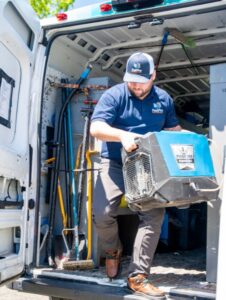
- Low-grain refrigerant dehumidifiers — these are the workhorses of professional water damage drying. They pull large volumes of moisture out of the air far more efficiently than anything designed for home use, and they’re built to run continuously under demanding conditions
- Desiccant dehumidifiers — particularly effective in cooler environments or when very low humidity levels need to be achieved, desiccant units use absorbent material to capture moisture and can reach dryness levels that refrigerant units alone can’t always match
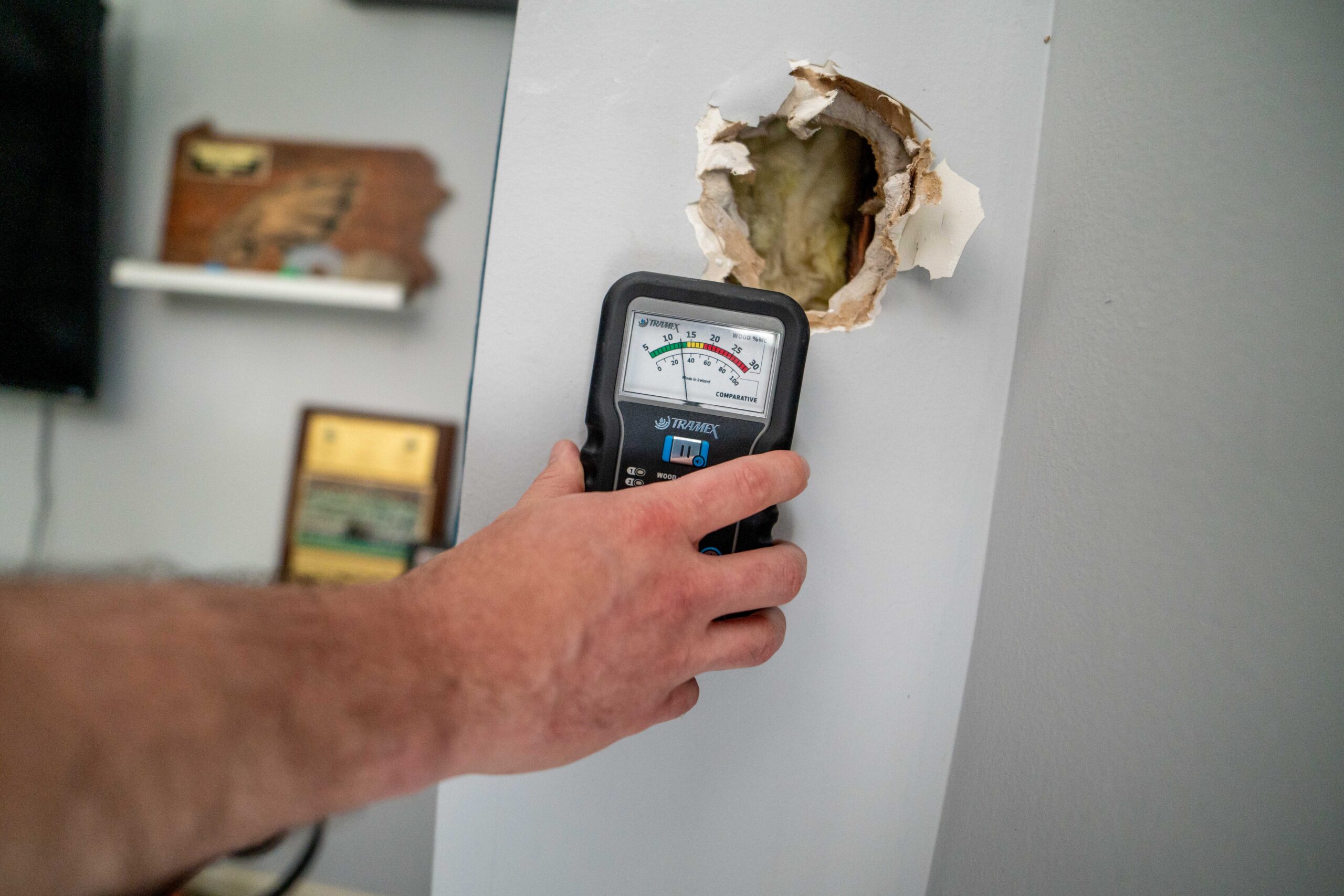
- Moisture meters — rather than guessing whether materials are dry, professionals use moisture meters to get actual readings from walls, floors, and structural components. This is what separates thorough drying from drying that just looks complete
- Thermal imaging technology — infrared cameras can detect moisture hiding behind walls, under flooring, and in other areas that aren’t visible to the naked eye, ensuring that hidden problem areas get identified and addressed
- Hygrometers and psychrometric monitoring tools — these track temperature, relative humidity, and other air conditions throughout the drying process, giving restoration professionals real-time data to adjust equipment placement and confirm when true dryness has been achieved
What all of this adds up to is precision. Professional dehumidifying isn’t just about running powerful machines and hoping for the best. It’s a monitored, data-driven process that continues until moisture readings throughout the entire structure — not just the surface — come back within acceptable ranges.
That level of accuracy is what makes the difference between a home that’s truly restored and one that develops problems weeks or months down the road.
Final Thoughts
Water damage recovery is not as simple as getting rid of the water you can see. In a lot of ways, the harder part starts after extraction is finished.
Once the standing water is gone, moisture is still present — hidden inside walls, absorbed into building materials, suspended in the air throughout the space. And if that residual moisture isn’t dealt with properly, it keeps doing damage long after the original event is over.
That’s exactly why comprehensive dehumidifying is such an essential part of the process. Done right, it protects the structural materials that hold your home together, reduces the risk of mold taking hold, keeps your indoor air quality from deteriorating, and helps preserve the furniture, documents, and belongings that matter to you. It also plays a direct role in keeping restoration costs from climbing higher than they need to.
There’s a real difference between a building that’s been partially dried and one that’s been truly restored — and dehumidifying is what bridges that gap. You can extract every drop of standing water, but without bringing moisture levels back to where they should be throughout the entire structure, the job isn’t finished.
Fast extraction matters. But comprehensive dehumidifying is what actually completes the restoration. If your home or property has experienced water damage, make sure the team you work with treats drying as the priority it is — not an afterthought once the water is gone. Therefore, contact FastPro for help.
Frequently Asked Questions About Dehumidification
Why is dehumidifying important after water damage?
Dehumidifying removes excess moisture from the air, helping prevent mold growth, structural deterioration, and lingering odors
How soon should dehumidifying begin after water damage?
Ideally within the first 24 hours to reduce the risk of mold development and secondary damage.
Can fans replace dehumidifiers?
No. Fans promote evaporation, but dehumidifiers remove moisture from the air and complete the drying process.
How long does dehumidifying take after water damage?
Most projects require several days, though severe water damage may require one to two weeks.
Does dehumidifying prevent mold?
It significantly reduces the conditions mold requires to grow by lowering humidity levels.
Can water remain inside walls after surfaces appear dry?
Yes. Moisture often remains trapped inside wall cavities, insulation, and structural components.
What humidity level is considered safe after water damage?
Most restoration professionals aim for indoor relative humidity below 50%.
Are household dehumidifiers sufficient after flooding?
Typically not. Significant water losses often require commercial-grade restoration equipment.
What happens if dehumidifying is skipped?
The property may experience mold growth, material deterioration, odors, and increased repair costs.
How do professionals verify a structure is dry?
They use moisture meters, hygrometers, thermal imaging devices, and documented drying standards.